
Digital Product Passport software for EU product data
Digital Product Passport software should do more than generate a QR code or publish a static product page. It needs to turn product, supply-chain and regulatory information into a structured record that can be maintained for years, accessed across markets and updated without replacing the physical data carrier. DPPora brings those jobs together in one guided workspace and publishes hosted, multilingual product passports.

Digital Product Passport software should do more than generate a QR code or publish a static product page. It needs to turn product, supply-chain and regulatory information into a structured record that can be maintained for years, accessed across markets and updated without replacing the physical data carrier. DPPora brings those jobs together in one guided workspace and publishes hosted, multilingual product passports.
What is Digital Product Passport software?
Digital Product Passport software is the operational layer between a company’s product data and the digital record reached from the product. A useful platform organises identifiers, product attributes, materials, responsible economic-operator details, supporting evidence and product-specific regulatory information. It then publishes that information through a durable web destination while preserving the controls needed to update, version and maintain the record. This is fundamentally different from creating a one-off PDF or a temporary marketing page: the passport is intended to remain useful as the product moves through its lifecycle.

A stable product identity, not a disposable web page
A physical QR code may remain attached to a product long after the first passport is published. The software therefore needs a stable product identity and hosted URL. DPPora separates identifiers such as GTIN, EAN, model and batch information from the stable hosted passport destination, so the public record can evolve without requiring a replacement QR code. Published versions remain traceable and older versions can be viewed as read-only history while the current record stays clearly identified.

Structured materials and composition data
Materials should be managed as structured data rather than buried inside free text. DPPora records material names, composition percentages and countries of origin, checks the overall composition and presents the result clearly in the public passport. This makes the information easier to review, translate and extend when product-specific rules require additional attributes. Structured composition is also more useful for downstream repair, recycling and circularity workflows than an uploaded document that cannot be interpreted as product data.

Repair, recycling and sustainability information in the same record
A Digital Product Passport can connect product identity with practical lifecycle information. DPPora keeps repair guidance, recycling information and sustainability information alongside the core product record instead of scattering it across unrelated pages. The public passport can therefore remain useful after the point of sale: a user, repairer, recycler or other authorised participant can reach the relevant information from the same durable product destination.

Responsible economic operator and manufacturer information
Product data is only part of the compliance picture. The passport also needs to identify the responsible economic operator and preserve the company information associated with the published record. DPPora supports organisation profiles, manufacturer or other operator roles, registered address, email, international telephone number and website details. Company information can be maintained centrally while passport history preserves the relationship between a published product record and the operator information that applied to it.
Product-specific EU regulatory data
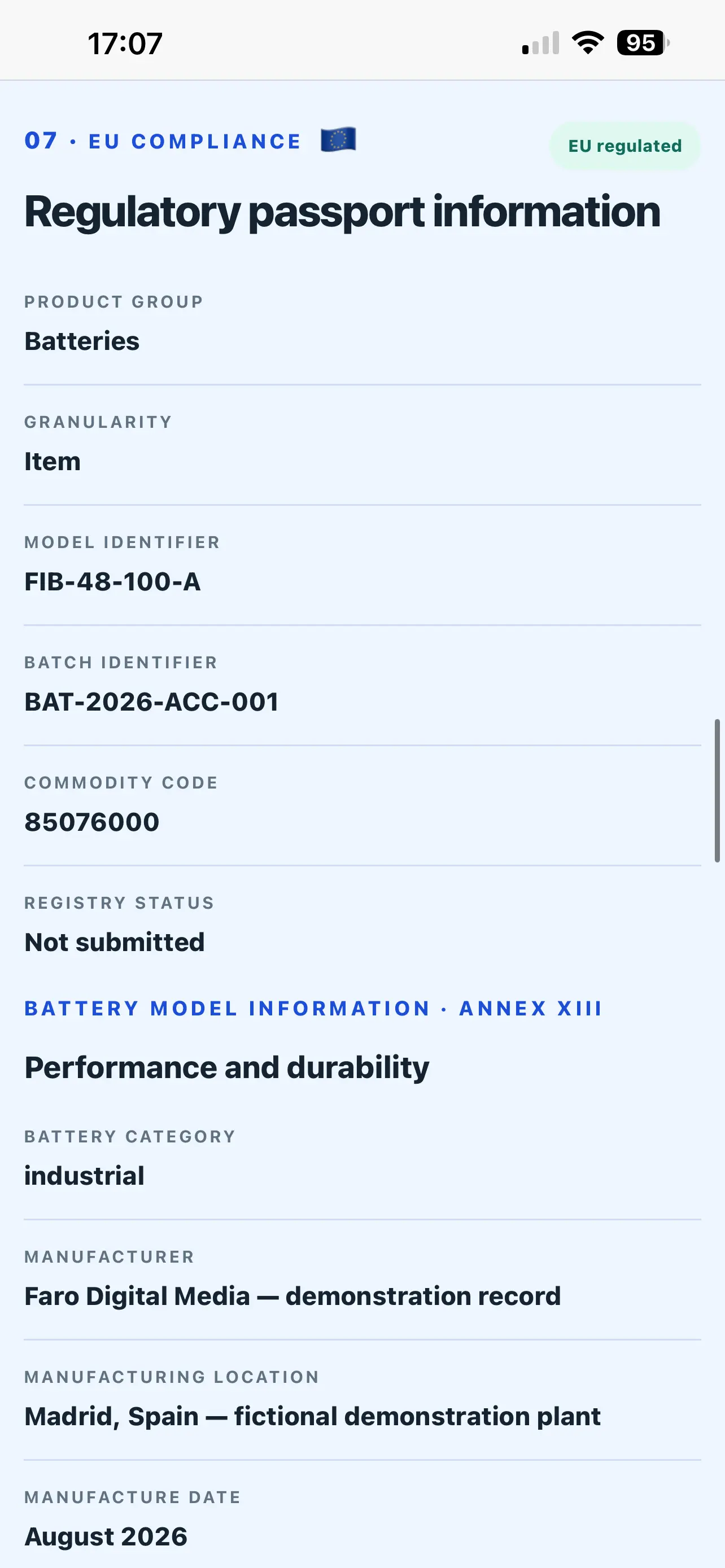
Different product groups do not share one universal set of passport fields. Good DPP software therefore needs a regulatory data model that can evolve by product category rather than forcing every product into the same generic form. DPPora’s demonstration battery passport shows this approach with battery identity, category, manufacturing information, capacity, energy, chemistry, voltage, performance, durability, sourcing, markings, conformity, waste-management and other regulatory fields grouped into a readable public record.

Carbon footprint, recycled content and environmental declarations
Sustainability claims become more useful when they are structured, attributable and connected to the product they describe. The battery implementation demonstrates lifecycle carbon-footprint data, footprint intensity, lifecycle stages, methodology, performance class and recycled-content declarations. DPP software should make these values maintainable and understandable without turning the public passport into an unreadable database dump, while retaining supporting evidence where the applicable rules require it.
One passport, multilingual access
Products cross borders, but issuing a different QR code for every language would undermine the idea of a stable product identity. DPPora keeps one passport destination and supports multilingual public views. Interface labels and translatable product content can be presented in the viewer’s language while identifiers, URLs, units and other values that should remain stable are preserved. Translation caching keeps frequently viewed language versions fast while the original record remains accessible.
Evidence, version history and lifecycle maintenance
Publishing is not the end of the workflow. Product information can be corrected, regulatory fields can mature, supporting documents can change and products can be discontinued, withdrawn, recalled or reach end of life. DPP software should preserve an auditable history rather than silently replacing yesterday’s record. DPPora maintains passport versions, supporting evidence and lifecycle state while keeping the stable public destination available while hosted.
QR codes, GTINs and scalable product onboarding
A QR code is the access mechanism, not the passport itself. DPPora links a durable QR destination to structured product records and supports identifiers such as GTIN and EAN. For organisations managing more than a handful of products, the workflow also needs to move beyond typing every item individually. Structured product onboarding and reusable organisation data reduce duplication and make it practical to prepare larger catalogues while keeping each published passport connected to the correct product identity.
What to look for when choosing DPP software
Choose a platform around the lifecycle of the record, not just the appearance of the QR code. Look for stable hosted URLs, structured product and material data, responsible-operator information, product-specific regulatory fields, multilingual public access, evidence handling, version history, lifecycle status, scalable onboarding and an architecture that can adapt as delegated acts and technical requirements mature. Avoid systems that lock the passport into a static PDF or require a new physical code whenever the underlying information changes.
See a working Digital Product Passport
The best way to understand Digital Product Passport software is to inspect a real record. DPPora’s live demonstration battery passport is a fictional product built specifically to show the complete workflow: stable hosted identity, multilingual access, version history, materials, responsible economic operator, EU regulatory information, battery performance and durability, carbon footprint, recycled content and lifecycle information. Scan the QR code or open the example directly to see the public passport as a user would see it.
See a working Digital Product Passport
Automatically import your own catalogue
Look up any GTIN and automatically populate drafts with available GS1 product identity and photos. GS1 source fields remain read-only. Publishing requires a matching GS1 licence approved by DPPora. Submit licence evidence in Company profile. Import limits and passport allowances apply.
DPPora is an independent service with access to the Verified by GS1 API. DPPora is not operated by GS1, and API access does not imply GS1 endorsement or certification.